Chapter 01
Nobody had named the problem yet, so I started by naming it.
At the time, three teams inside Amazon held three different opinions about what Prime should sound like, and members were hearing all of them at once. Research kept arriving from every direction, but each team was reading its own version in isolation, which meant the conflict never got resolved at the level it needed to.
I started by reading every value-communication-adjacent research study I could find. Four major ones existed, completed over eighteen months across three different teams, and while each was a useful finding on its own, reading them together was where the verdict emerged. So I synthesized them and brought leadership a single diagnosis.
Then I mapped the internal landscape. Three sets of guidelines were quietly competing for authority across Prime surfaces: Amazon's RIO standards, the Brand voice (Charm and Disarm), and Prime's own retention strategies. Each was strong on its own. Together, they left a gap nobody owned: how Prime talks about its value to members.
I brought both findings to leadership in a single document. The recommendation: Prime needed a framework that owned the gap between strong benefits and the weak communication around them.
Prime kept telling members what they saved. It rarely told them they mattered.
There was also a value bias to address. Prime's communication leaned hard on shipping speed and the headline benefits. Members already knew about shipping; saying it again was noise. The dozens of secondary perks had low adoption and felt irrelevant when surfaced. The new system needed to be customer-backward, built from what members noticed and needed.
The counterfactual was concrete: with no shared model, the benefits would have kept shipping and the language would have kept fragmenting, with each team optimizing to its own loudest stakeholder. The framework's job was to make that fragmentation visible and replace it with a shared one.
Chapter 02
I built the framework by winning the first fight.
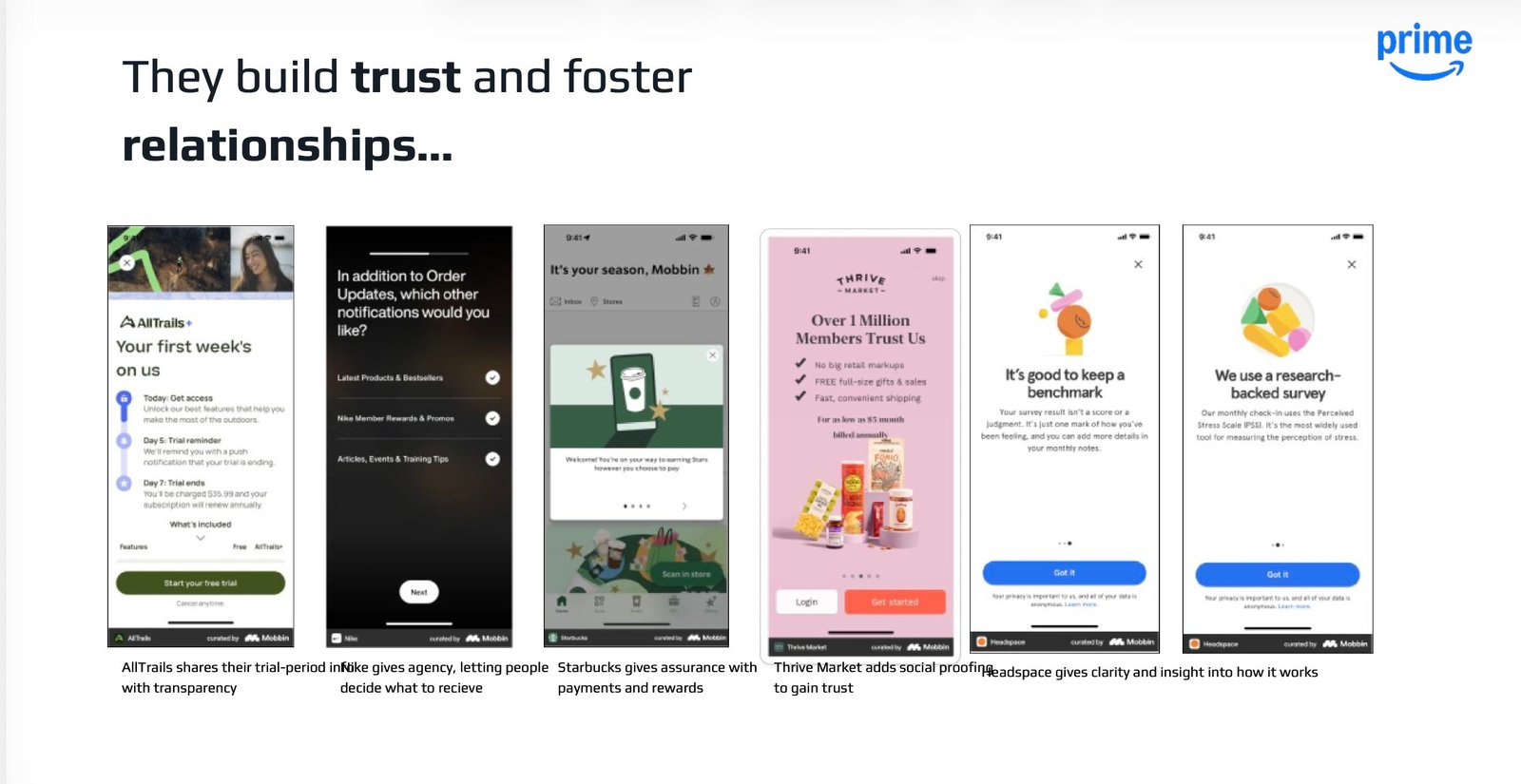
The first decision was about who Prime was being measured against. Senior leadership wanted a benchmarking cohort of Costco and Walmart Plus, which would have anchored the framework to a price-comparison story. I argued for a different cohort: AllTrails, Nike, Starbucks, Thrive Market, Headspace, Target, Duolingo, Spotify. The brands members trust, and the standards Prime was being measured against whether the org said so or not.
I made the case in a deck and a working session. A Costco comparison would have optimized for price-per-benefit and produced more of the same headline-savings copy. A high-trust brand comparison would optimize for the relationship Prime was failing to build, which was the actual problem in the diagnosis. Spotify was the threat we hadn't named. The audit was approved, and that decision shaped everything downstream because it set the bar the framework had to clear.
From there, I designed the system to be answerable to four inputs at once, because anything less would have made it opinion and anything more would have made it unreadable. Every principle, tone, and rubric question started from what members noticed and needed, so the structure inherited the customer-backward stance from the inputs.
What the high-trust audit returned.
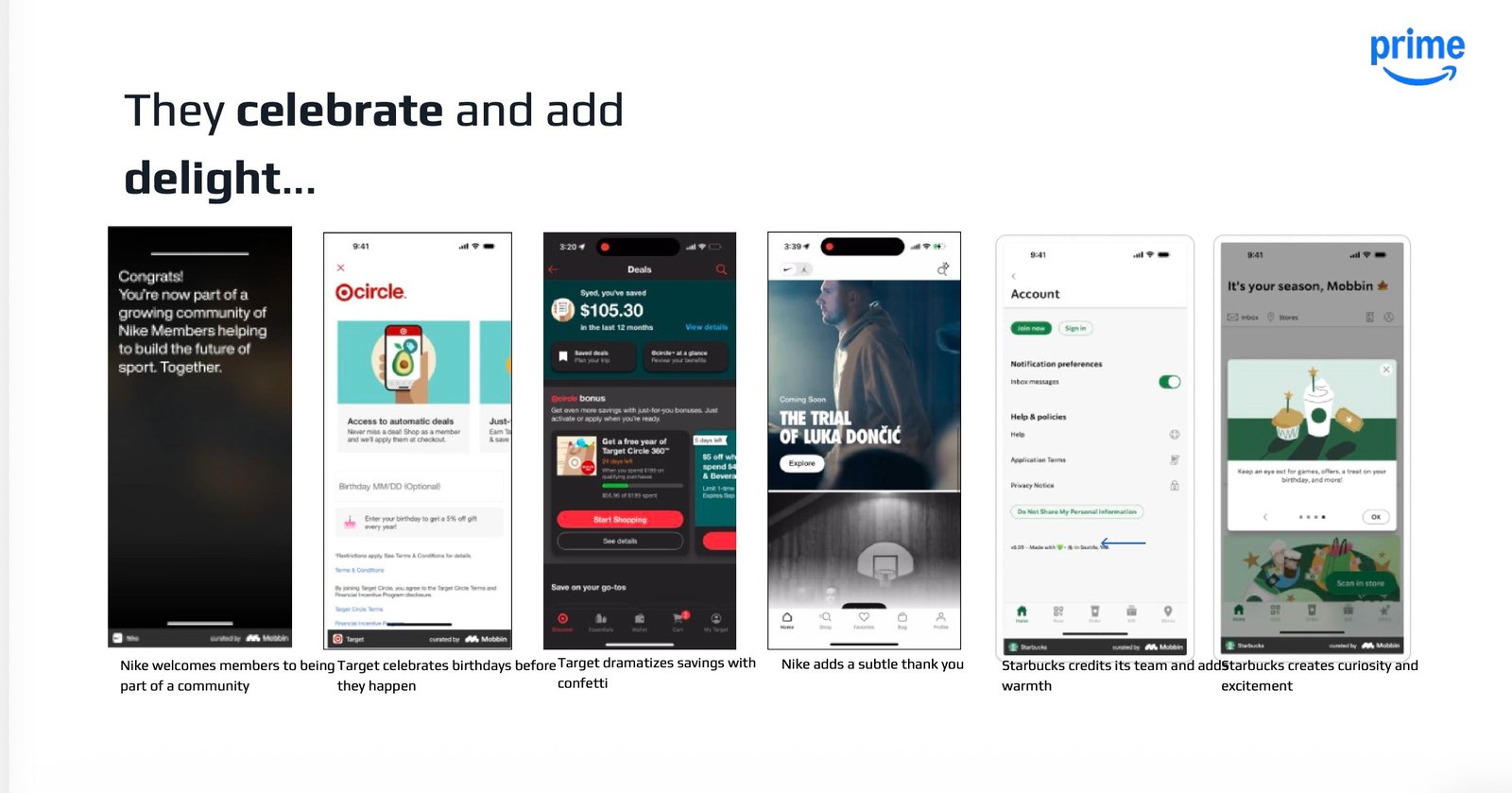
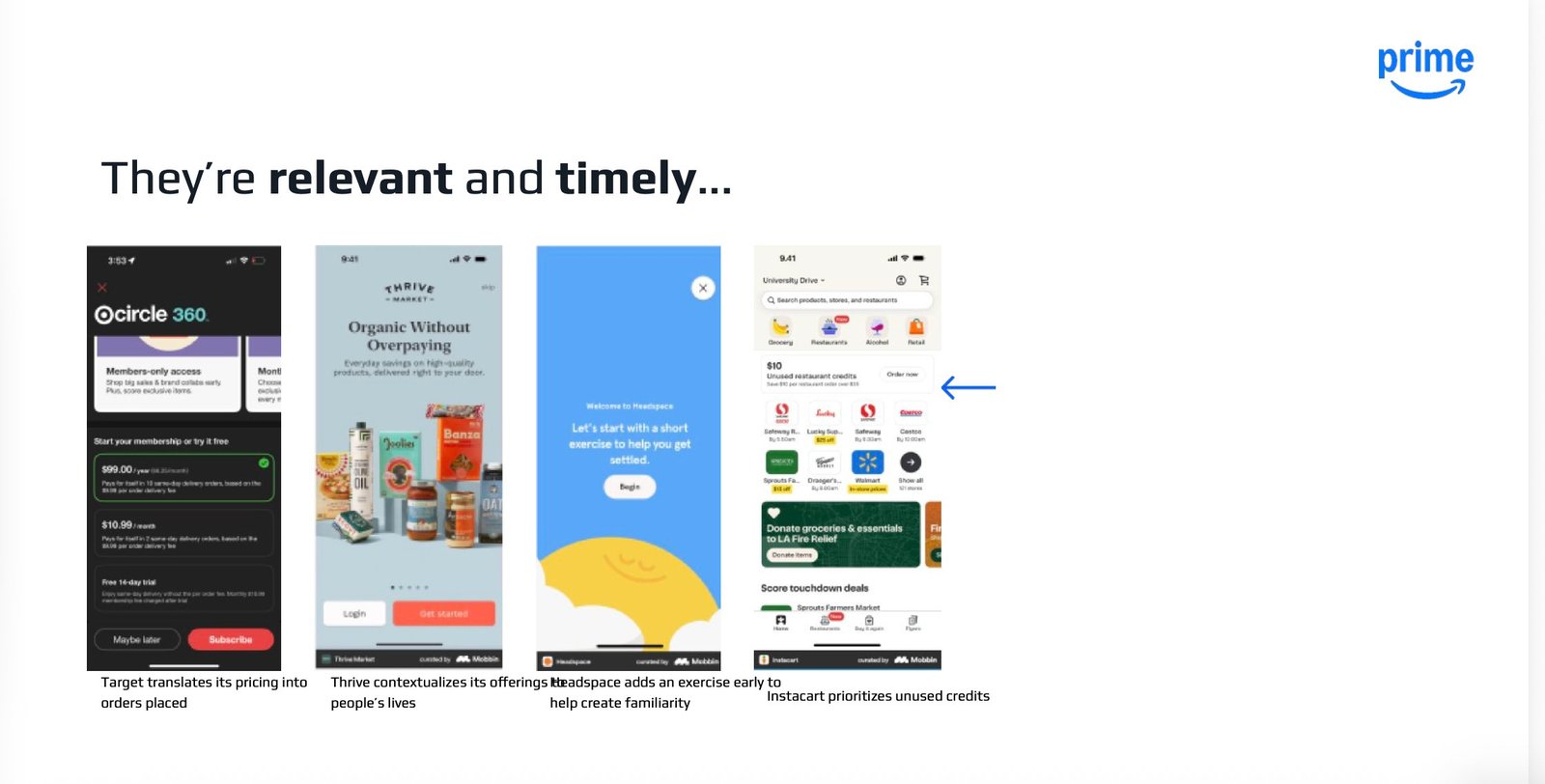
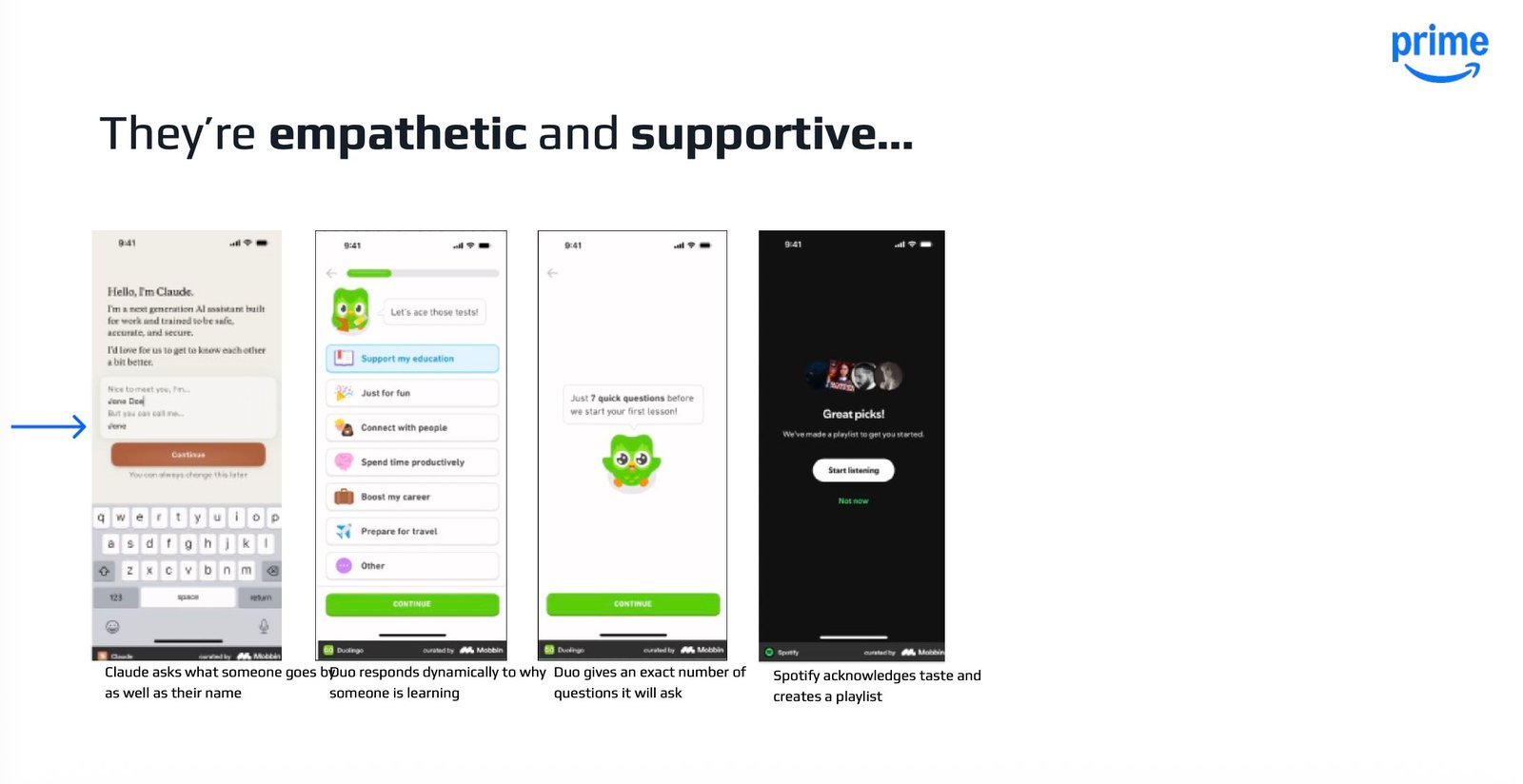
I documented the patterns from real product surfaces across the audit cohort: the language, the timing, and the trade-offs each brand made. Four behaviors showed up in every one, and they became the backbone the framework's principles were tested against.
I documented the patterns from real product surfaces: the language, the timing, the trade-offs each brand made. Below: the source material the audit was built on.
From four inputs to one architecture.
The architecture mapped five Value pillars through three Content Principles to nine Tones, read left to right. Writers don't pick one principle and ignore the others; they pick where the emphasis sits.
The five Value pillars cover what Prime delivers. The first three (Monetary, Convenience, Access) were familiar to the org. Trust and Emotion were the fight. Research showed they carried more retention weight than savings did. I argued the case in research review. Both pillars were added.
The strategic call: add Trust and Emotion to the value model. Research showed they drove retention harder than savings. That decision reshaped every principle and tone that followed.
The three Content Principles describe how to write about that value. The argument: emotion creates consistency, confidence, familiarity, and the relationships retention depends on.
Intuitive
Monetary + Convenience
ComprehensibleEfficientTangible
Members grasp what Prime does without translation. Copy connects benefits to real-world habits and shows, instead of tells.
Pertinent
Convenience + Access
AdaptiveContextualRelevant
Prime evolves with the member's journey. Content anticipates needs, surfaces value at the right moment, personalizes based on behavior.
Empathetic
Emotion + Trust
DependableConsiderateCelebratory
Prime delivers on what it says. Builds confidence through consistency, respects member context, creates moments of recognition that aren't tied to an offer.
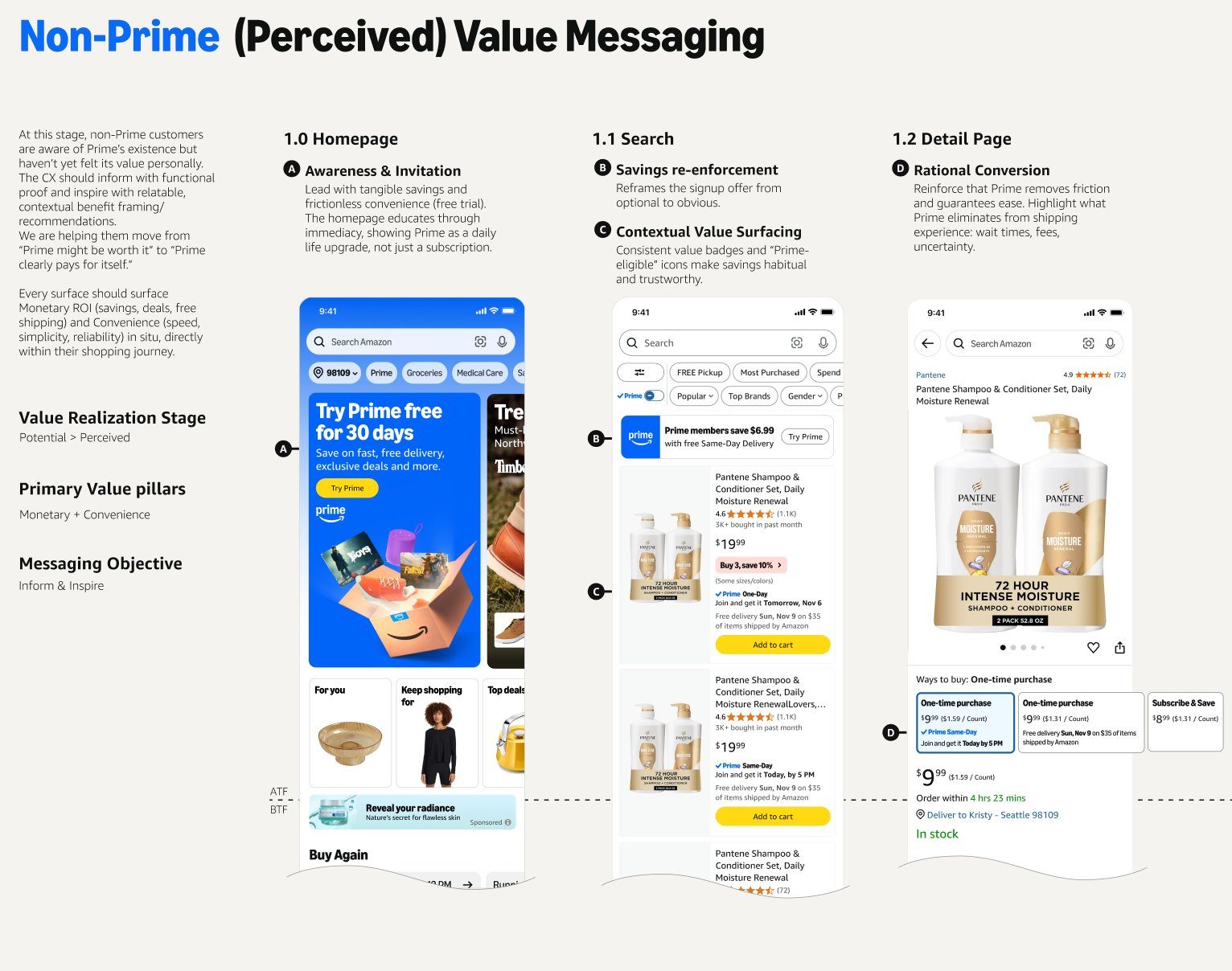
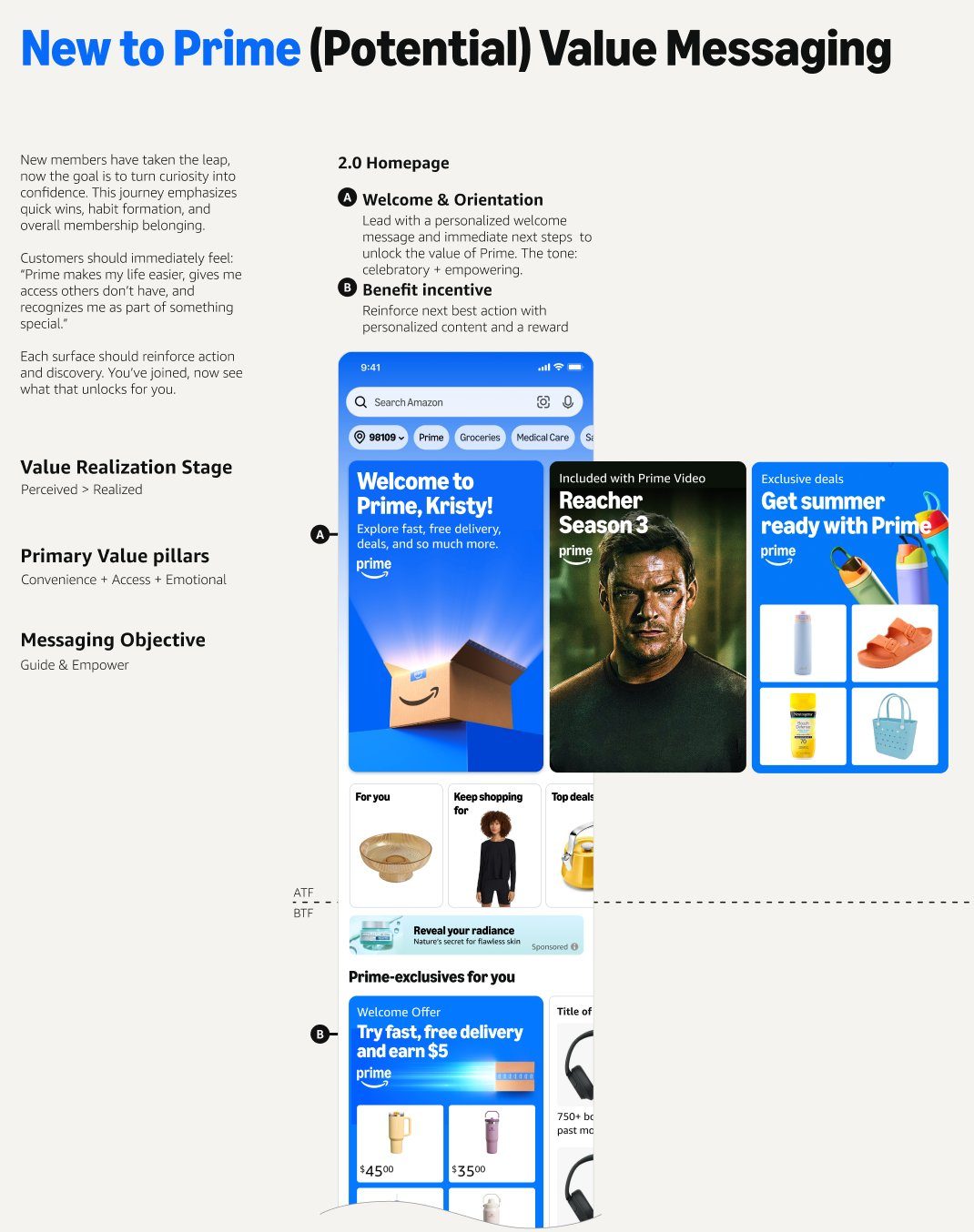
The architecture also had to be legible to every person who'd ever touch Prime content: writers, PMs, marketers, designers, eventually AI agents. So I named the surfaces explicitly. Where value communication lives, and who sees it.
Chapter 03
Four artifacts turned the framework into a practice.
A framework on a slide doesn't ship. It needed four operational artifacts to scale beyond me, and I built each one with the people who'd use it.
Artifact 01 / The matrices.
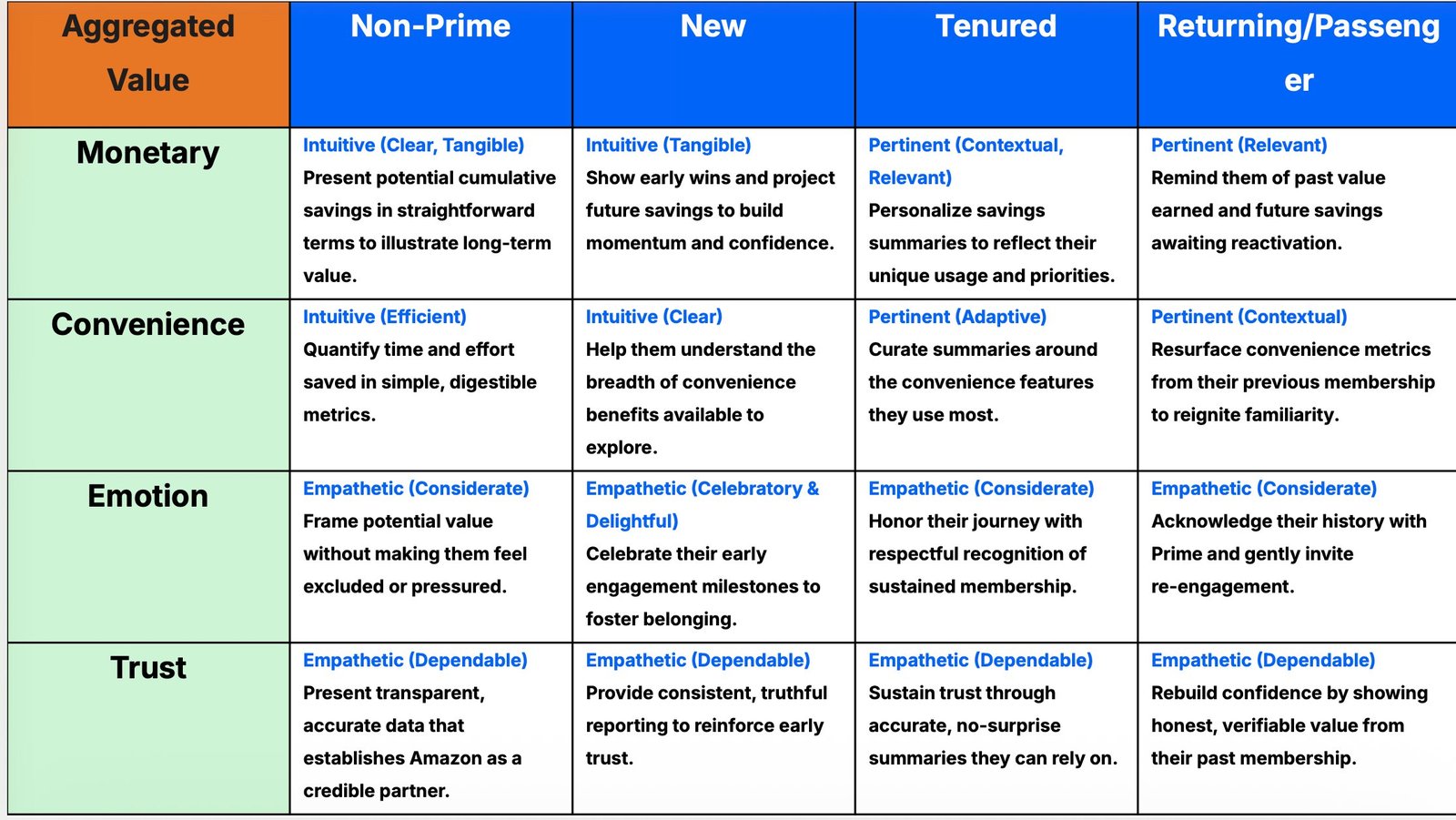
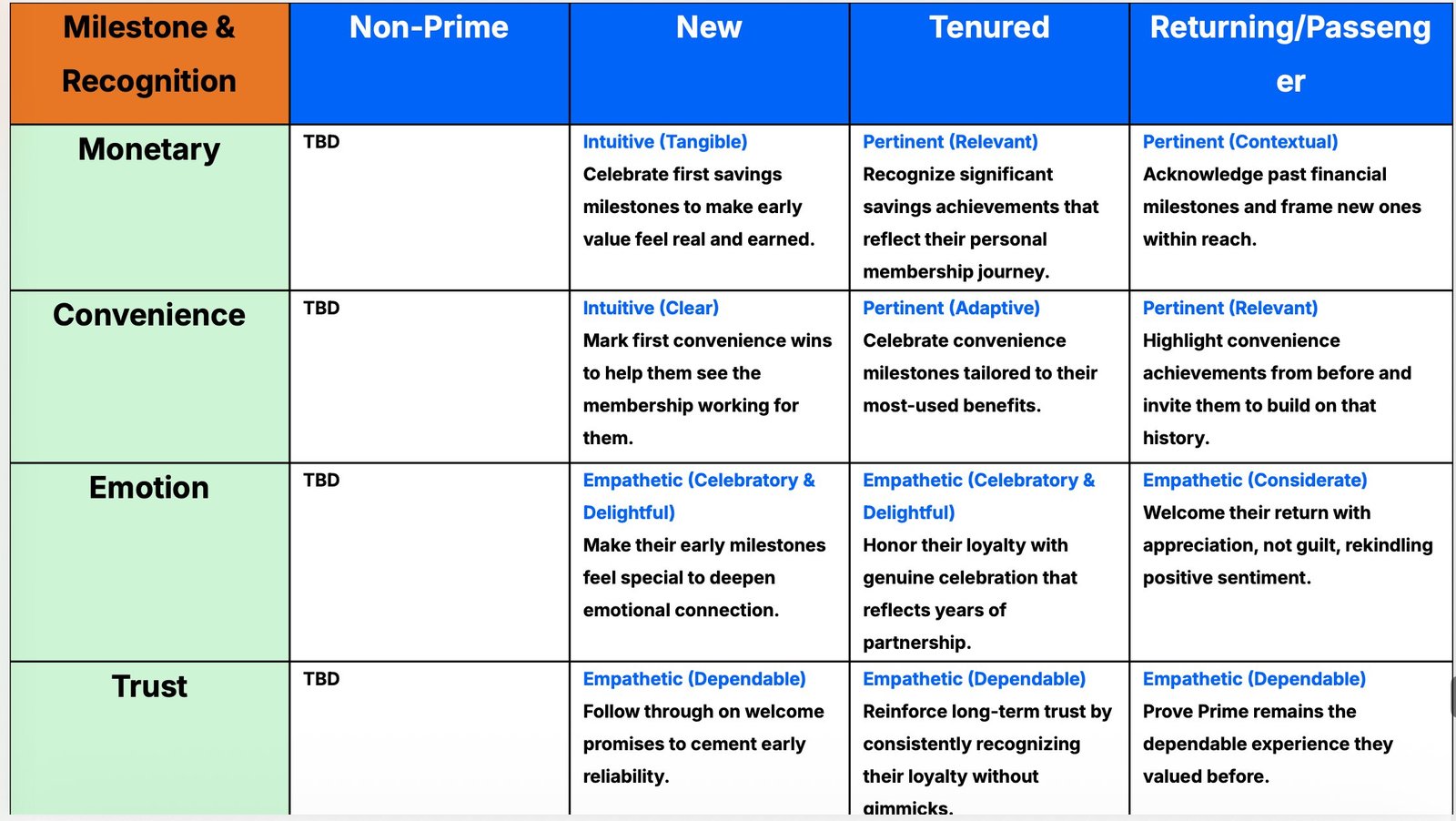
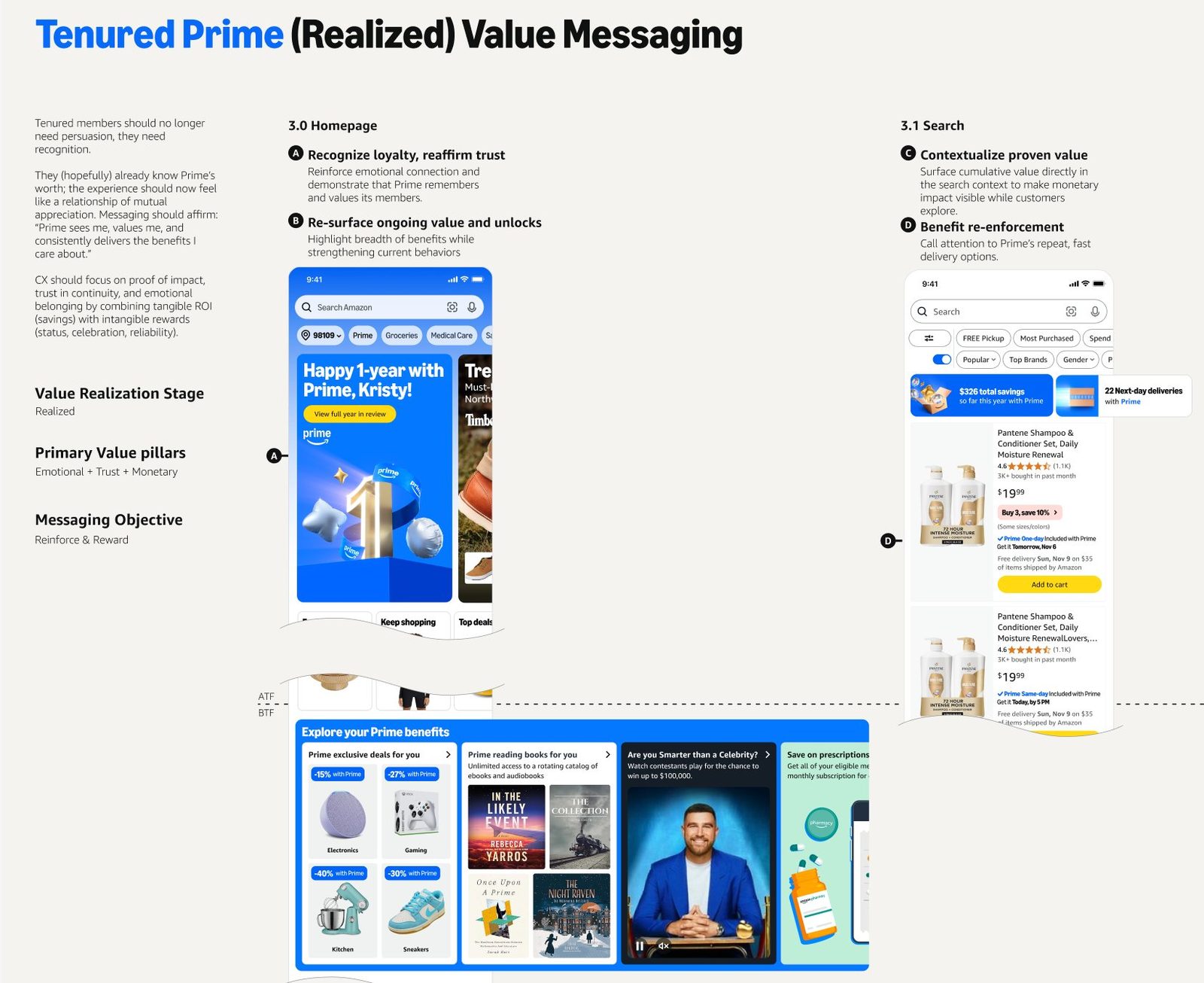
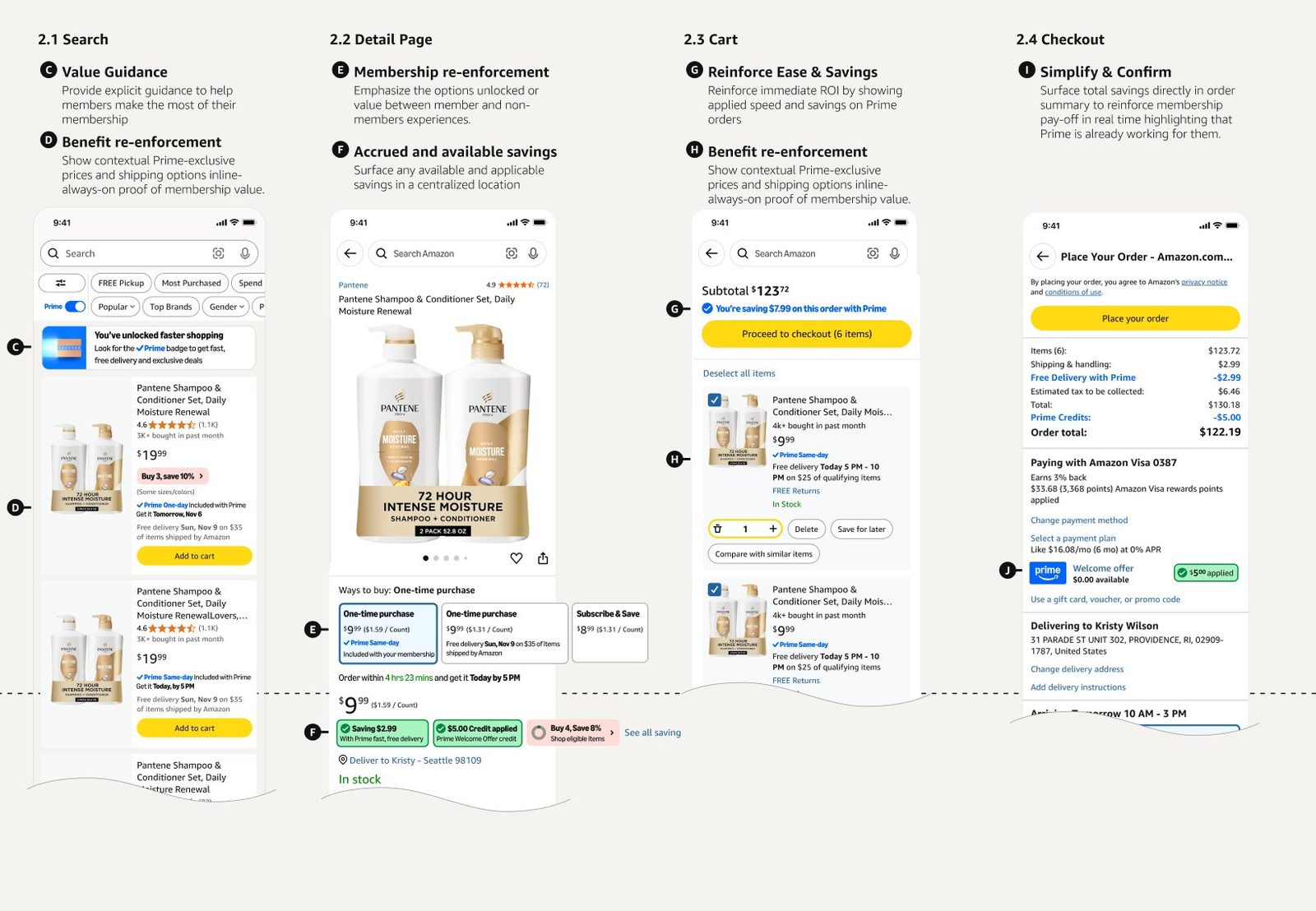
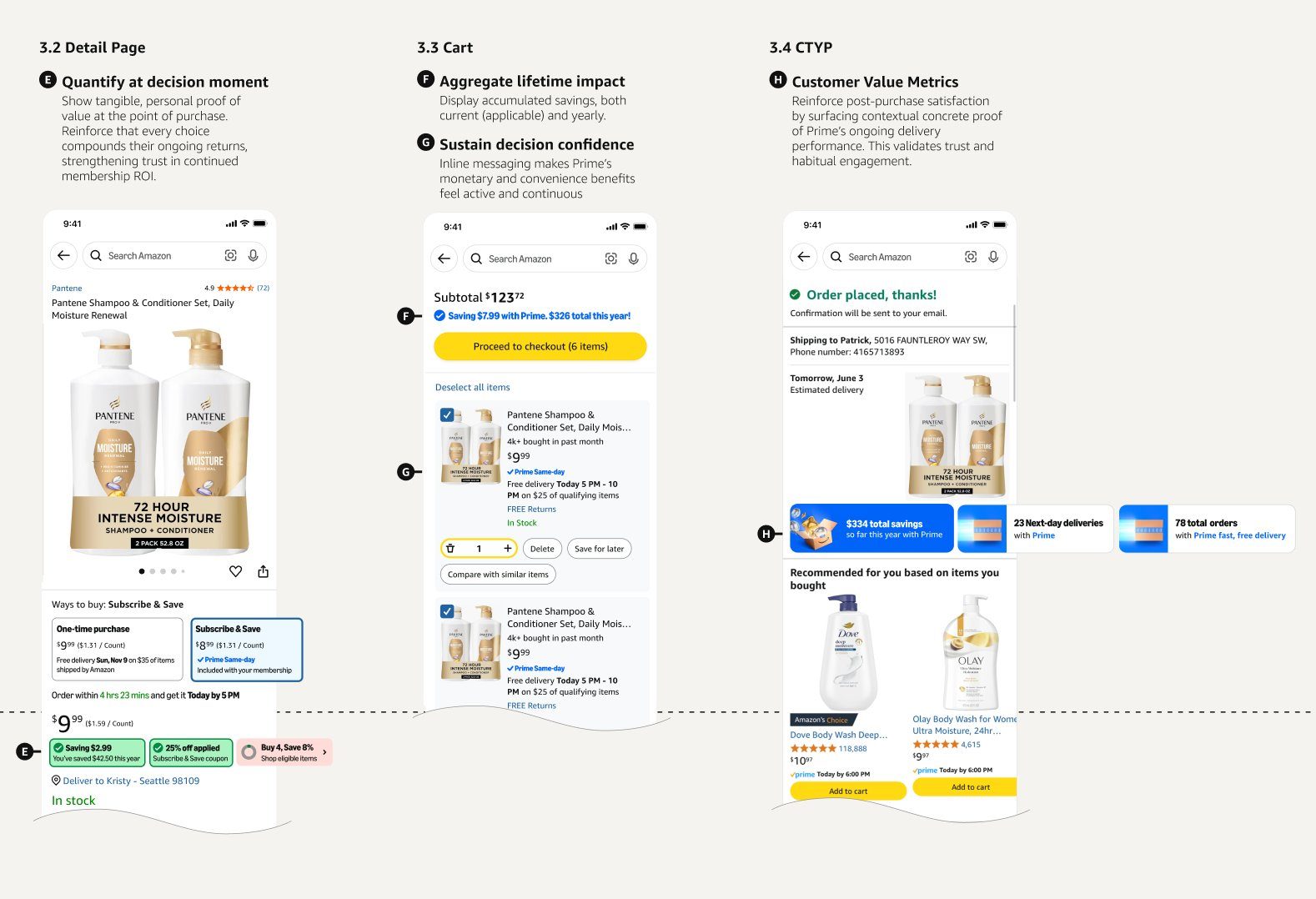
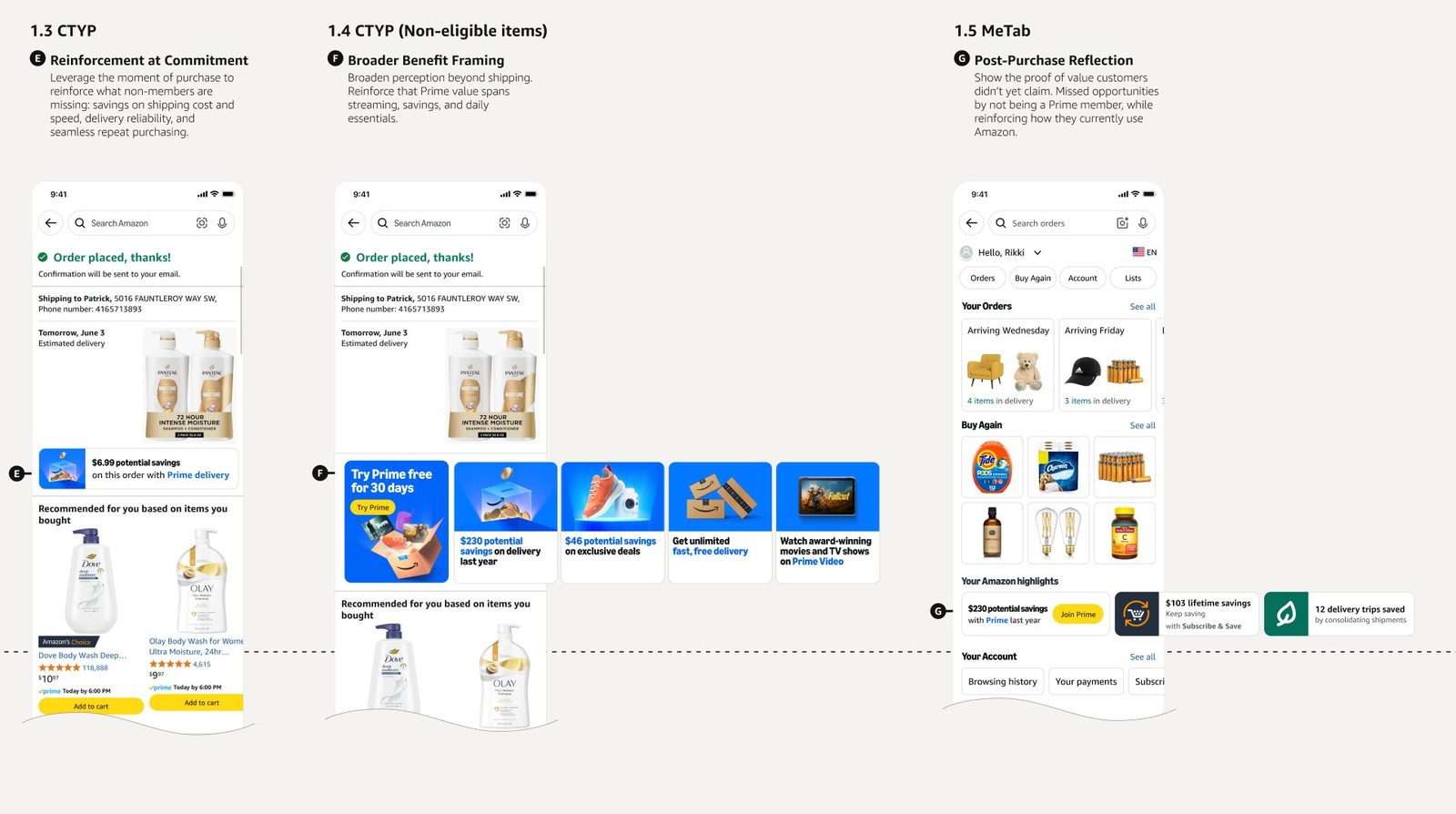
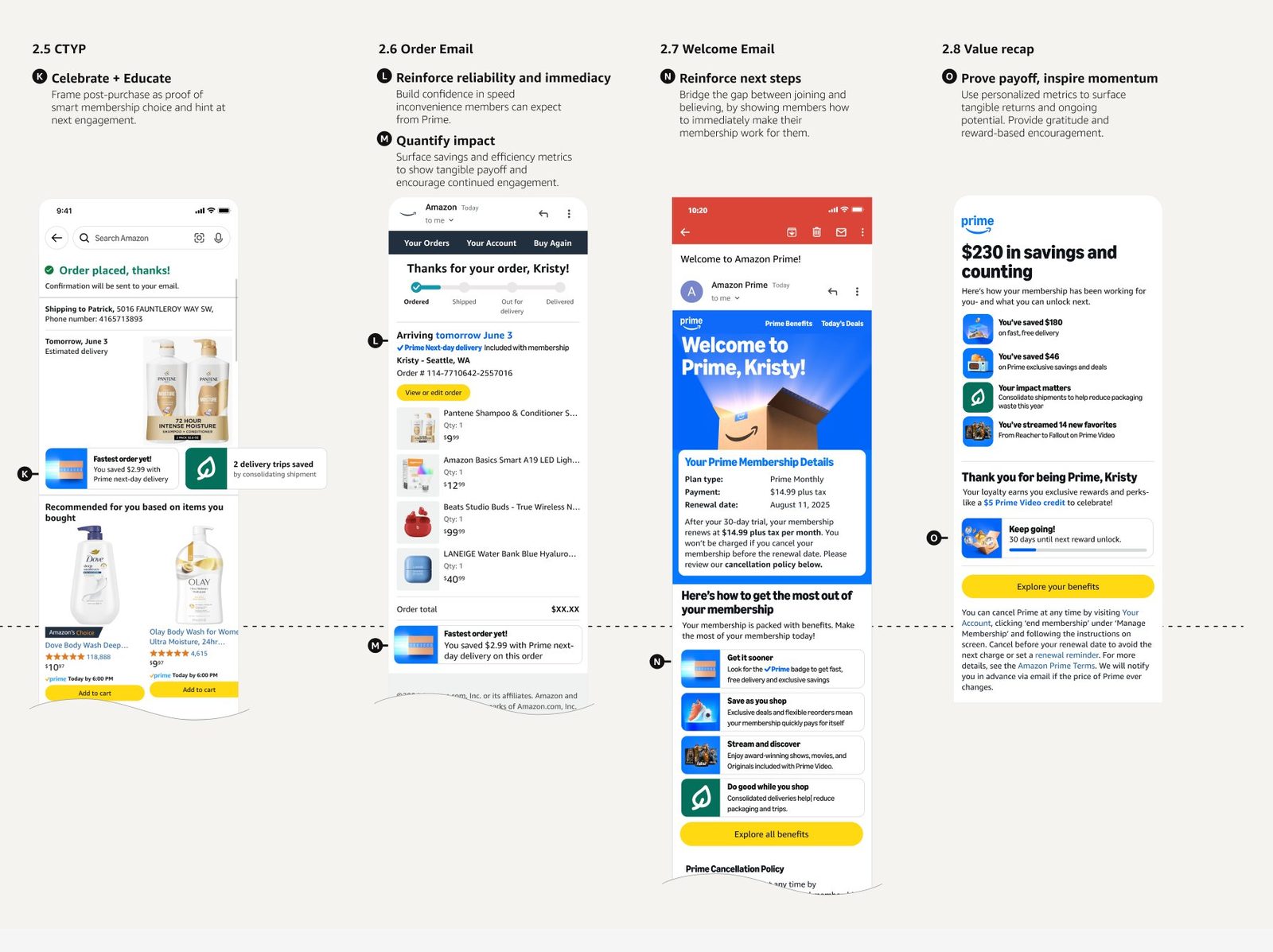
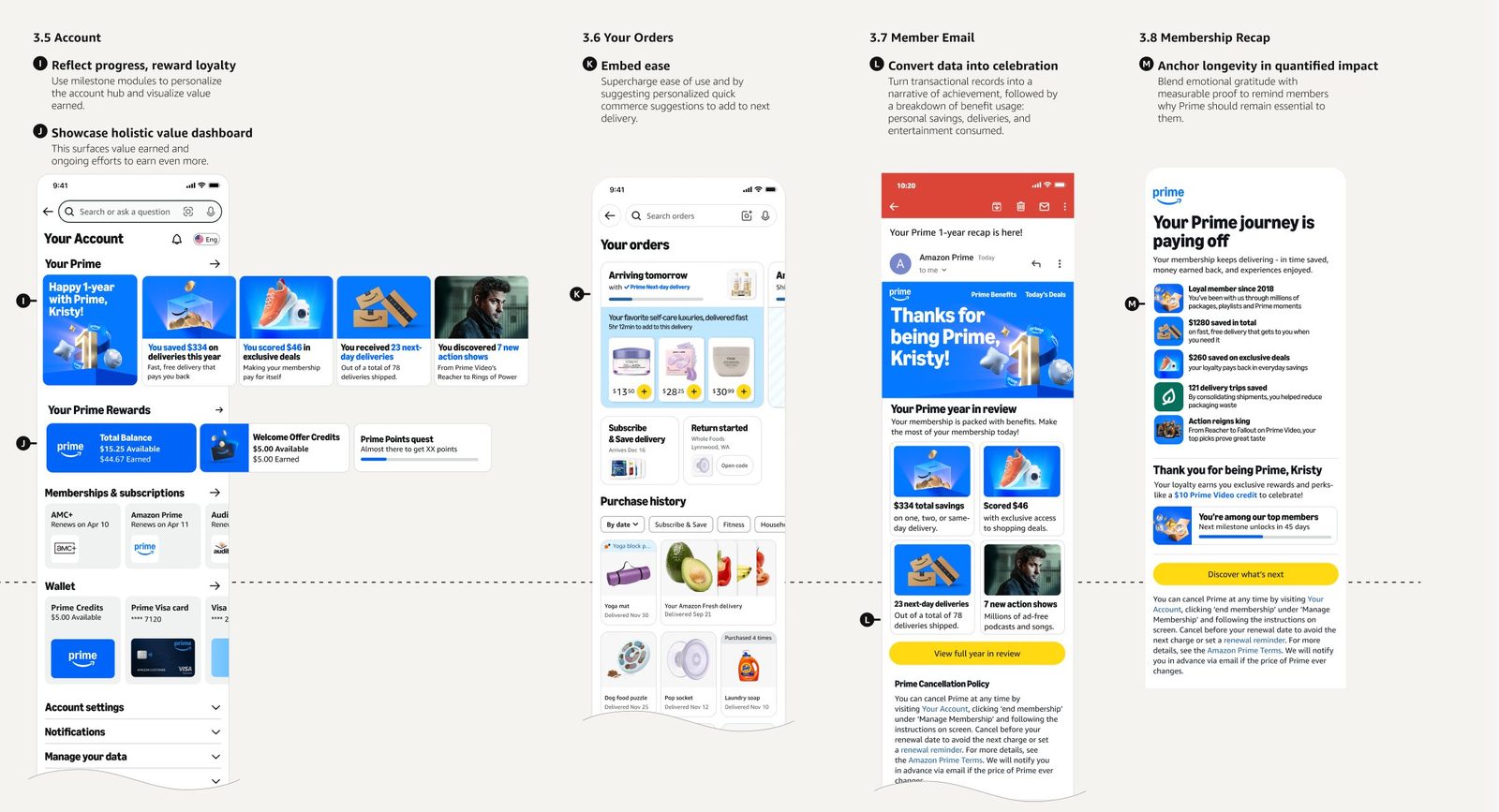
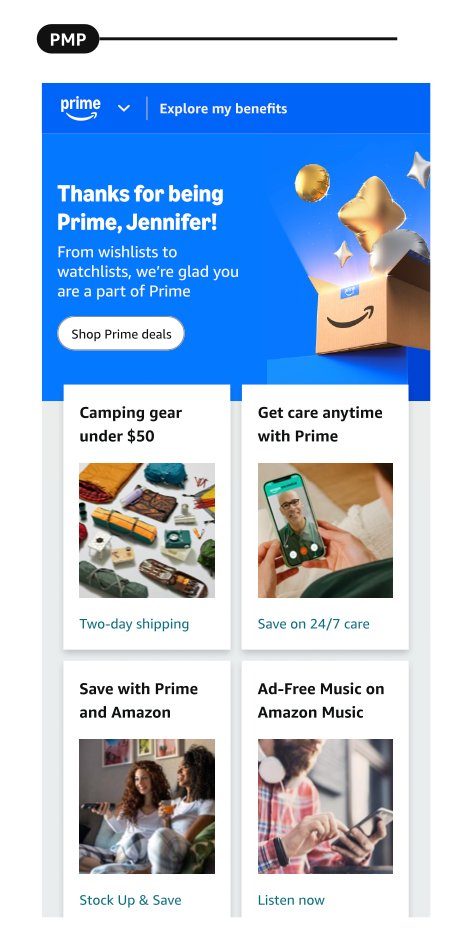
Two operational matrices translated the principles into specific content moves for every audience-and-surface combination. Aggregated Value covered the savings dashboards and benefit summaries, while Milestone & Recognition owned anniversaries, achievements, and welcome moments. Together they answered the question every writer kept asking the brief: which tone for which surface, for which member, at which moment?
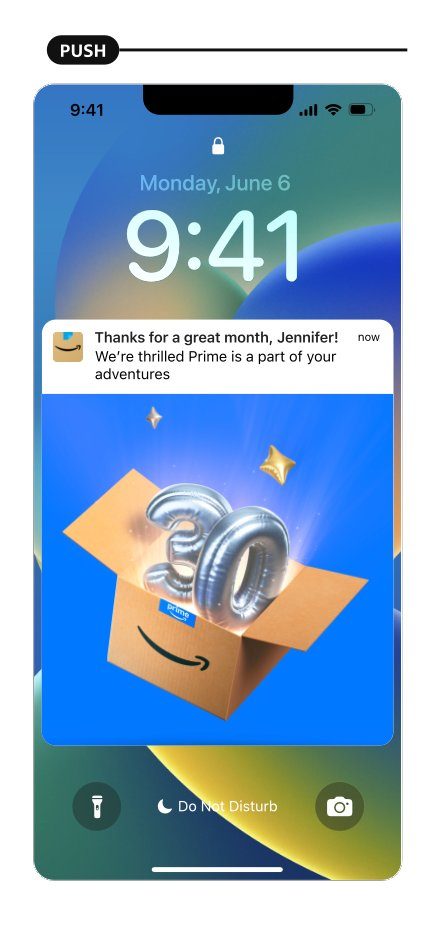
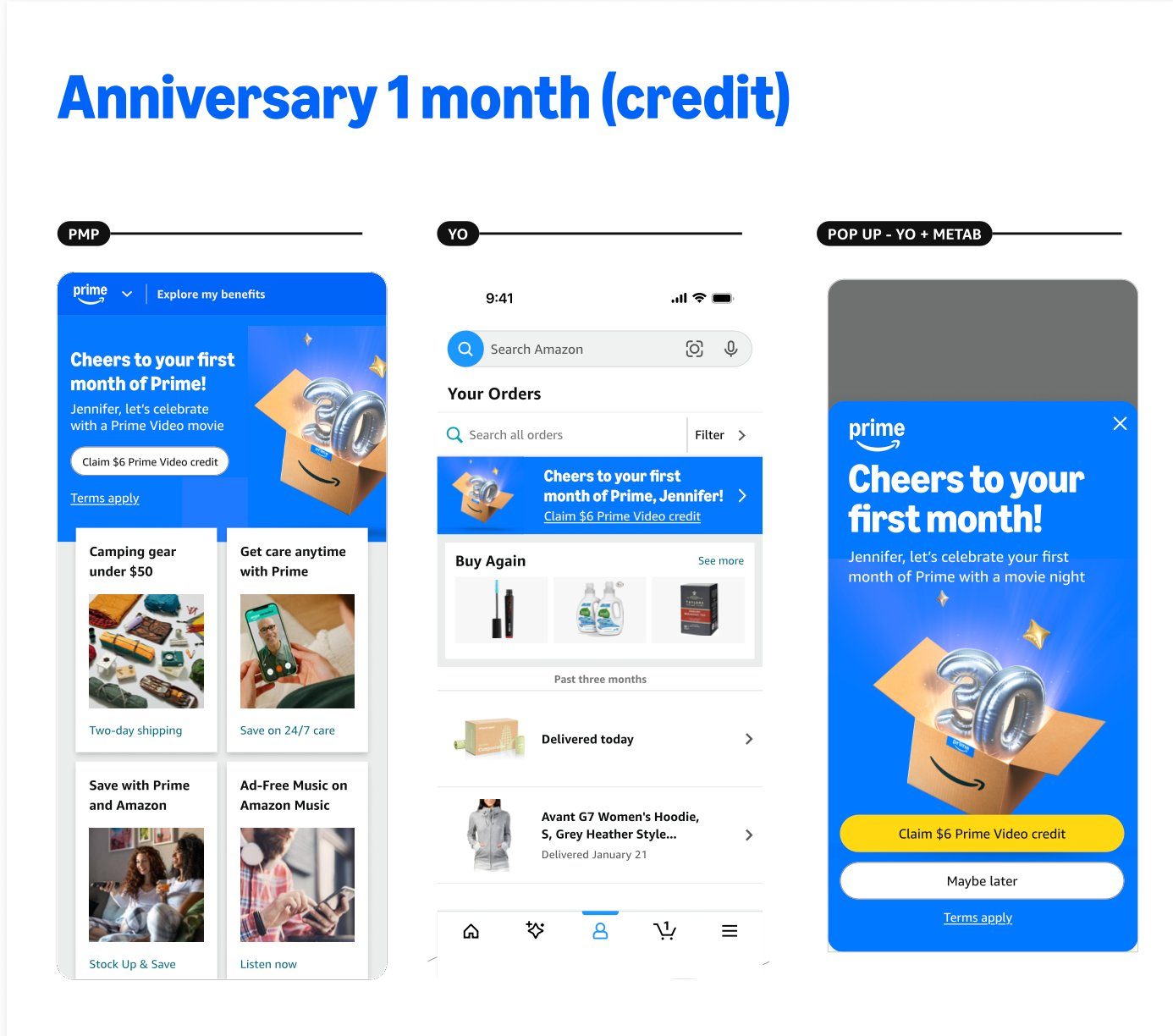
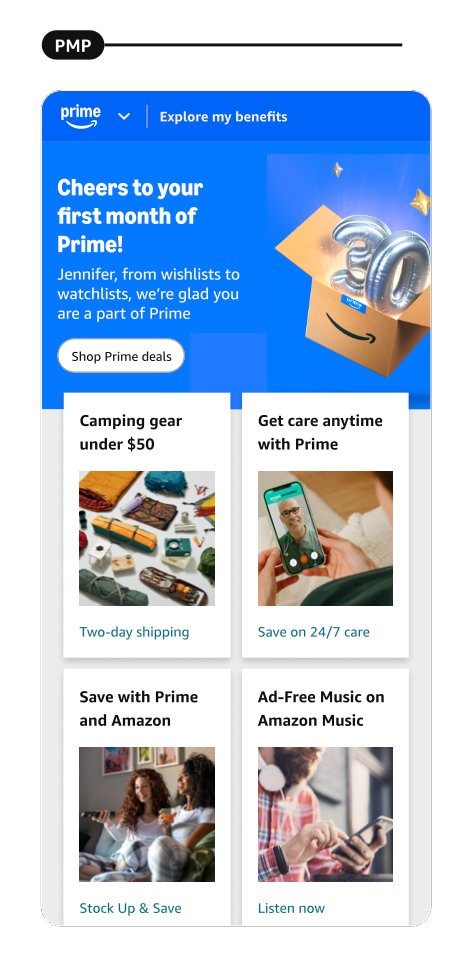
The framework at copy level. A 30-day welcome card for a new member, before and after:
Before
Welcome to Prime! Enjoy fast, free shipping on millions of items, plus exclusive deals and entertainment.
After
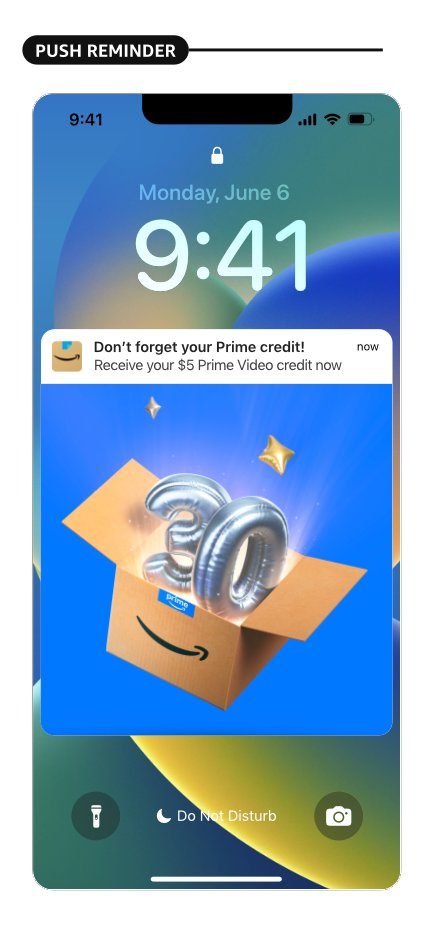
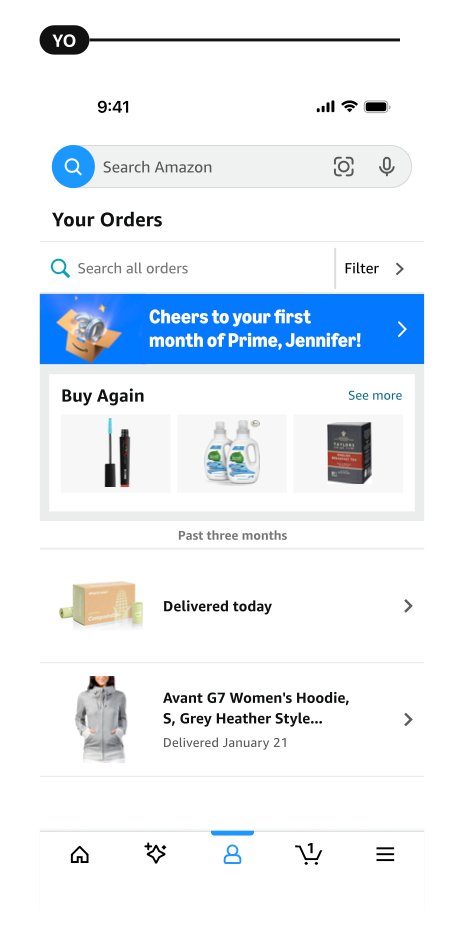
A month in. We're glad you're here. So far Prime has saved you 14 hours and $47, and it's only getting started.
→ Empathetic (Celebratory & Delightful) layered with Intuitive (Tangible). Honors the milestone, makes value concrete, opens forward.
Before
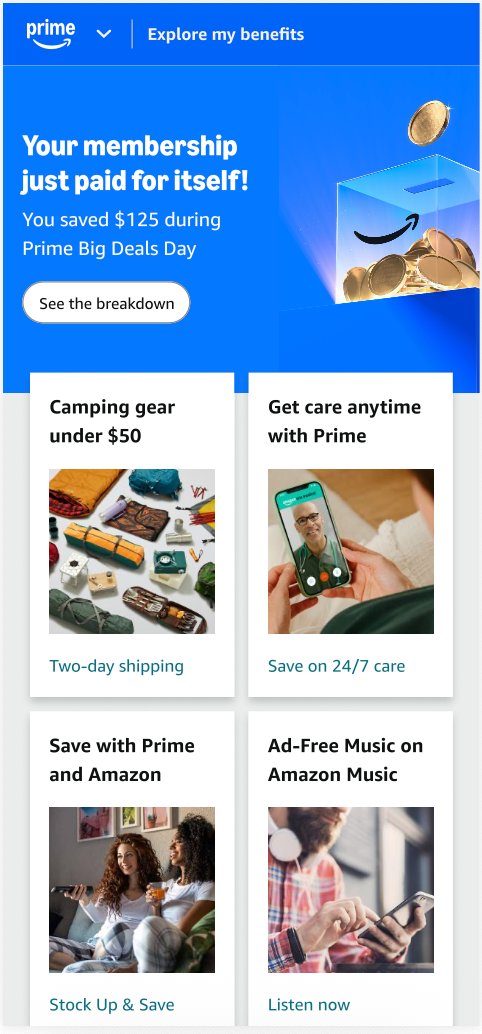
Your Prime Savings: $312 saved this year on shipping and exclusive deals.
After
Three years with Prime. This year alone, your membership returned $312, 47 hours of shipping time, and 184 movies and shows. Your top-used benefit: same-day delivery on weekday afternoons.
→ Pertinent (Contextual + Relevant) leading, Intuitive (Tangible) supporting. The time anchor ("three years") taps recency and salience to ground the member in a habit they already trust, and the dual-channel proof (dollars + hours + movies) lets one reading carry both abstract savings and concrete usage. Same-day delivery as the "top-used benefit" leans on existing affordance strength instead of introducing new ones.
Before
We miss you! Come back to Prime and rediscover your benefits. Free shipping, exclusive deals, and more await.
After
It's been a while. No pressure. Whenever you're back, your benefits are still here, and three new ones launched while you were away.
→ Empathetic (Considerate + Dependable) leading, Pertinent (Adaptive) supporting. Lowers the emotional cost of returning by removing guilt cues, and the "three new ones launched while you were away" line adds positive novelty without the loss-aversion pressure of a deadline. Treats absence as adult behavior, which is what makes the return feel like a choice rather than a recovery.
Artifact 02 / The writing process.
Four steps with checkpoints, designed to scale to non-writers.
Artifact 03 / The rubric.
The rubric was the artifact I co-designed most closely with UX research. Working with research solidified my conviction: Prime was failing emotionally, and A/B testing alone missed it. A/B optimizes for clicks. It narrows success to single-point conversions, hides emotional response, and rewards false positives that can look like wins quarter over quarter. The framework needed a measurement layer beyond clicks. The rubric became that layer.
Structurally, it is a four-quadrant scoring instrument covering Value Clarity, Audience Alignment, Context & Timing, and Communication Style, with five points possible per quadrant for a total of twenty. Each quadrant is built from explicit yes-or-no questions a non-writer can answer.
What the rubric looks like in use. The same surface (a 30-day welcome card), scored before and after the framework took hold:
Draft 01 · Pre-framework
"Welcome to Prime! Enjoy fast, free shipping on millions of items, plus exclusive deals and entertainment."
Total: 11/20
→
Draft 02 · Framework-applied
"A month in. We're glad you're here. So far Prime has saved you 14 hours and $47, and it's only getting started."
Total: 18/20
Fig. 13 The rubric in use. Same surface, same brief, seven points of measurable improvement. The score is the conversation. The score is also what AI can be trained on.
Artifact 04 / The scaling plan.
Then the part nobody talks about: socialization. I ran sessions across content marketing, retention, acquisition, and the brand team. The pattern was consistent. Agreement in the room, drift the moment people went back to their briefs. The framework needed three commitments to take hold.
The realization curve: how value moves through time.
The framework also accounted for time, since members don't experience value all at once. They move through a curve of promised, perceived, and proved, and each stage requires different content moves for different segments. This map became the briefing tool I gave PMs before any new surface review.
The hardest decisions I made.
Frameworks read clean in retrospect, but the decisions that built them never do. Three I'd defend in any interview:
Decision 01
Collapse four principles to three. An earlier draft had a fourth principle for Trust. I argued in research review that trust and emotion belonged inside Empathetic rather than alongside it. Three principles were defensible in a workshop. Four were a list.
Decision 02
Audit Spotify over Costco. Senior leadership wanted price-comparison. I argued for high-trust brands instead. Spotify was the relationship Prime was failing to build. Won the case with a deck and a working session.
Decision 03
Build the rubric before the principles were finalized. Conventional sequence is principles → matrix → rubric. I built the rubric in parallel because measurability was the only thing that would let the framework scale to AI. The rubric forced the principles to stay specific.